Category: E2
-
Passing the CIMA E2 Exam!
Passing the CIMA E2 Exam! Passing my E2 exam first time was a welcome relief after my experiences with failing the F2 exam a couple of times earlier this year. The E2 exam itself felt easier than I expected but this could be down to the fact I was really well prepared coupled with fact…
-
CIMA E2: Company Culture
Understanding company culture is part of the CIMA E2 syllabus and is an easy one for most people to relate (assuming you have some experience in the workplace). Culture is described as a combination of beliefs, values and standards of behaviour that are inherent in an organisation. Company Culture For example, you might work in…
-
CIMA E2: Managing Change
Syllabus area D of the CIMA E2 paper revolves around managing change through projects. It’s covers 30% of the paper so you need to know enough detail to be able pass the E2 objective test. Lewins 3 step model of change Our good friend Lewin is back with another model, this time it’s his theory…
-
CIMA E2: Porters Five Forces
Porters Five Forces is a topic that came up in my recent CIMA E2 studies and it was a model I was not that familiar with. Maybe it came up in my E1 exam but that seems a long time ago now. PESTEL analysis (Policital, Environmental, Social, Technology, Economical, Law) is used to understand the…
-
CIMA E2: Business Strategy
This article examines the CIMA E2 subject of formulating a buisness strategy. It looks at the four main types of strategy and what type of companies would employ them.
-
E2: The Project Management Life-cycle
Carrying on from last weeks post on the CIMA E2 subject “Project Management”, today I will be looking at the the four D’s that Maylor identified as the the project management life-cycle and what each stage means. Maylor – The Four D’s Well managed projects, as identified by Maylor, will plan to go through the four…
-
E2: Project Management
What is Project Management? Project management is a topic that crops up in the E2 syllabus and the official definition from CIMA can be seen below: “The integration of all aspects of a project, ensuring that the proper knowledge and resources are available when and where needed, and above all to ensure that the expected…
-
Maslows Hierarchy of Needs
Maslow’s hierarchy of needs dates back to 1943 when Abraham Maslow identified five sets of needs that we need as individuals to function and then to flourish. It’s mapped out in a pyramid structure with each level needing to be fulfilled before moving onto the next. For example; the base level belongs to basic physical needs like…
-
E2: Useful Links and Resources
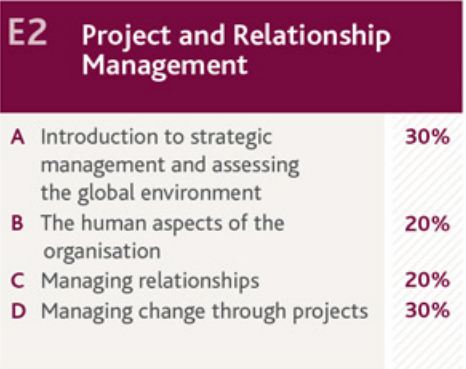
E2 Project and Relationship promotes an integrated approach to managing organisations from an internal and external perspective. It takes the knowledge you have gained from the E1 paper and builds on it by looking at the concept of strategy and how it can be implemented by people, projects, processes and relationships. Here are a come…
 The CIMA Student